

Predatory Lending
Predatory lending is the use of deception to get a borrower to accept financing with illegal terms, typically by using the complexity of the transaction to conceal the true cost of credit. Indeed, one government study found that most credit card agreements required reading at the college level, but that most credit card solicitations are written at an 8th grade level.
It’s no surprise, then, that many consumers—even very savvy ones—make systematic errors of judgment in evaluating credit. Most people focus on the monthly payment amount to estimate the cost of a loan, which is fine if the loans being compared are fixed-rate loans with the same term. But this monthly-payment-shortcut can be very misleading when comparing loans of different lengths or with adjustable interest rates. Worse, contract terms often are designed by creditors to encourage harmful choices by borrowers.
The ease with which a creditor can take unfair advantage can lead to extreme abuse when the consumer is also desperate to borrow money. Matters can get even worse where the consumer is unable to repay the high-cost loan and thus is forced to find yet additional high-cost credit to pay off the first loan. This spiral of debt makes consumers even more vulnerable and open to exploitation.
The Truth in Lending Act
The Truth in Lending Act (TILA) seeks to level the playing field by requiring lenders to clearly and uniformly disclose the true costs and terms of credit. Its primary goal is to empower consumers to easily compare loan offers, shop wisely, and avoid predatory or uninformed use of credit.
The TILA distinguishes between two types of credit: closed-end credit and open-end credit. The key distinction is whether the transaction contemplates a single lump sum disbursement (like a car or mortgage loan) or repeated draws against set limit (like credit cards or lines of credit).
For close-end credit, the lender must accurately disclose the amount financed, the finance charge, and the annual percentage rate in in the so-called Truth in Lending box:

For open-end credit, the lender must disclose the following terms in the so-called Schumer box:
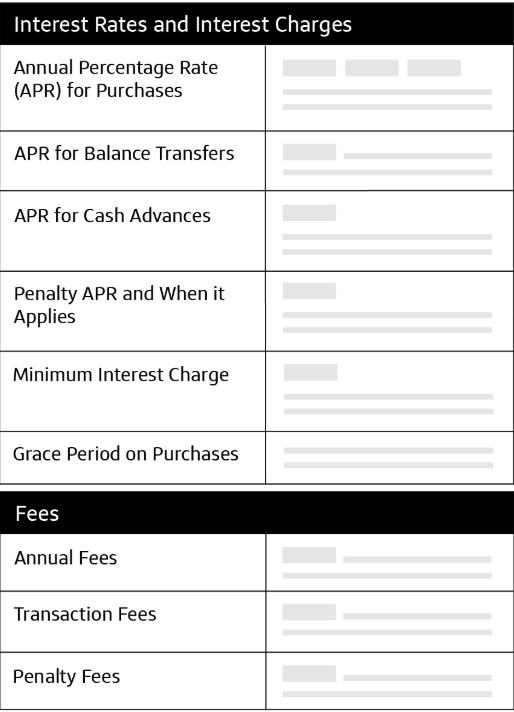
These uniform, consistent disclosures can then be used by consumers to compare two different credit products and make the best possible credit decisions.
How predatory lenders manipulate closed-end financing
Probably the most common abuse by closed-end creditors is to put finance-related charges in the “Amount Financed” box rather than in the “Finance Charge” box. This little trick will make the interest rate look lower than it really is.
Here's an example. Let's say you're financing a used car for $30,000. The annual interest rate is 13.99% and you’ll pay it off over 6 years (72 months). So the $30,000 purchase price would go in the Amount Financed box because it's the amount you're borrowing. And the interest amount ($22,343.73) would go in the Finance Charge box.
Because you're financing the transaction, the dealer requires that a GPS unit be installed so that it can locate the vehicle for a repossession if you fall behind on payments. The dealer charges you $1,000 for the GPS unit. Because the dealer allows you to roll this $1,000 charge into your loan, it goes in Amount Financed box right? Wrong. The GPS fee should be a Finance Charge because the dealer only requires these GPS units for buyers that finance. It doesn't require them for cash buyers. By fraudulently putting the GPS fee into the Amount Financed box, the dealer keeps the APR at 19.75%. But if the GPS fee was put in the Finance Charge box where it belongs, the APR jumps to 21.09%.
The takeaway? Make sure you carefully review the terms of your loan to make sure the creditor isn't trying to mislead you. Review every charge and ask yourself would the lender charge this in a cash transaction? If the answer is no, then it should be a finance charge and disclosed accordingly.
If the lender improperly discloses the financial terms or misstates the interest rate, it likely has violated the Truth in Lending Act. This would give rise to claims for statutory damages, actual damages, and the creditor would have to pay your attorney fees and court costs.
How predatory lenders disguise illegal interest rates
Let’s go back to our example of the auto loan with the $1,000 GPS fee. I already explained how the hypothetical dealer manipulated the credit terms to make the interest rate appear to be 19.75%, when it was actually 21.09%. And I explained how these inaccurate disclosures violated the Truth in Lending Act, giving the borrower a legal claim for statutory damages, actual damages, plus attorney fees and costs.
But let’s add another fact to the example—that the maximum rate of interest allowed by law for the car loan is 19.75% So not only did the dealer inaccurately disclose the true interest rate, it also charged an illegal rate of interest when the true interest rate is calculated This predatory and deceptive double-whammy leads to a second legal claim for charging a usurious interest rate.
Read more: What is the highest interest rate a lender can charge in Minnesota
Predatory new “fintech” loans
The word “fintech” is simply a combination of the words “financial” and “technology”. It describes the use of technology to deliver financial services and products to consumers. Fintech companies focus on technology-based solutions to traditional financing, often through websites or apps.
A widespread fintech “innovation” is to solicit payments from the borrower that are supposedly voluntary. For example, the payment may be for expedited delivery of the loan proceeds. The lender may even characterize a consumer’s payment as a “tip.”
This “tips” model is found in freestanding cash advance apps, as well as in loans in which third-party lenders purport to advance earned wages. Fintech companies utilize these tips as an attempt to mask finance charges and evade interest rate limits. Tips added by default can result in extremely high, often illegal, APRs and trap the borrower in a cycle of debt.
Minnesota has strong laws that cover many of these new fintech loans and advances, including an interest rate cap of 50%, which includes all fees and “tips.” Minnesota consumers have powerful remedies when a predatory lender runs afoul of these laws by charging illegal interest or fees.
Read more: Earned Wage Advances or Payday Loan Apps in Minnesota: What You Need to Know
Ready to talk to a lawyer about a predatory lending in Minnesota?

Since 2009, Todd has been helping people combat illegal practices by consumer predators. Todd’s clients have described him as “very professional and easy to work with.” He lives in Minneapolis with his wife and four children.